
IZZY (Host, CyberPink):
By now you’ve heard: Timothée Chalamet did not win Best Actor tonight. Michael B. Jordan did, for Sinners, and the Academy made its choice between two very different visions of American masculine ambition — the vampire blues epic that broke nomination records and the ping pong narcissist who spent the week before the ceremony selling fermented tofu in Chengdu.
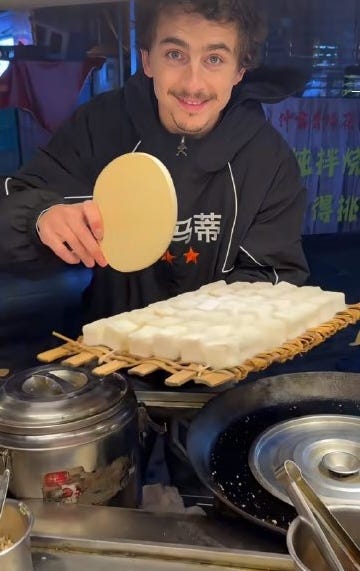
In retrospect, it was either one of the most confident moves of his career, or the tell. You don’t skip the guild dinners and the voter screenings and the careful late-season maintenance to go eat hotpot in Sichuan unless you’ve decided the Oscar isn’t the point. He came home from China without a statue and with something harder to name: a week of footage so effortlessly charming it already feels like mythology.
So: What in the Chinamaxxing world was this? Let’s go back to the beginning.
I was minding my own business, scrolling Xiaohongshu, when a thumbnail stopped me cold: a twinky white boy with a mustache, selling moldy tofu from a street stand. Xiaohongshu is one of the only platforms left where you actually have to click before seeing content in full. I did not click. AI-generated slop of Timothée Chalamet, my instinct said. Then I did a double take — because the caption read: Timotee Maimaiti (a common Uyghur name). Maybe a local Chalamet lookalike? I moved on. Hours later, the algo circled back, and I found out the truth: it was an authentic picture of Timothée Chalamet, selling dubious-looking tofu, on the street, in Chengdu.
Yiwen (Host, Pixel Perfect):
The AI-generated content paranoia is so real. Sign of our times.
IZZY:
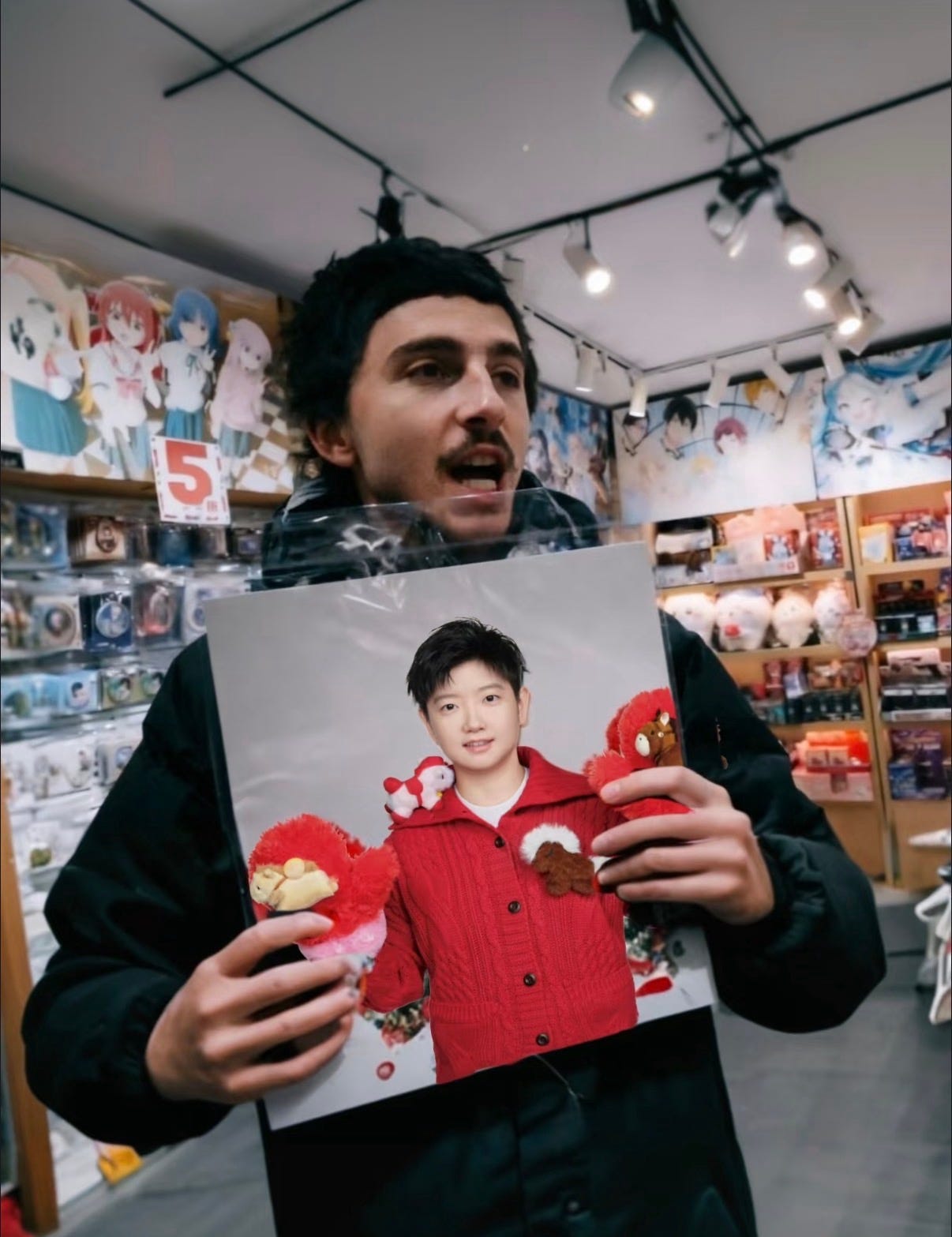
Turns out, Sweet Tea (甜茶, his extremely earned Chinese fan nickname) touched down in China and simply never broke character as Marty Mauser. He tracked down a poster of ping pong world champion Sun Yingsha like a true devotee. He took the metro. He ate hotpot until his face turned red. He wandered Beijing alleyways and then showed up at a university to shoot hoops with students. The bar for press tours has been raised, and it is now located somewhere in a Chengdu park at 8am, next to a group of uncles who will absolutely destroy you at ping pong. There's something pointed about a Best Actor nominee choosing to spend the week before the ceremony this way—courting Chinese fans instead of doing the careful rituals of awards season.
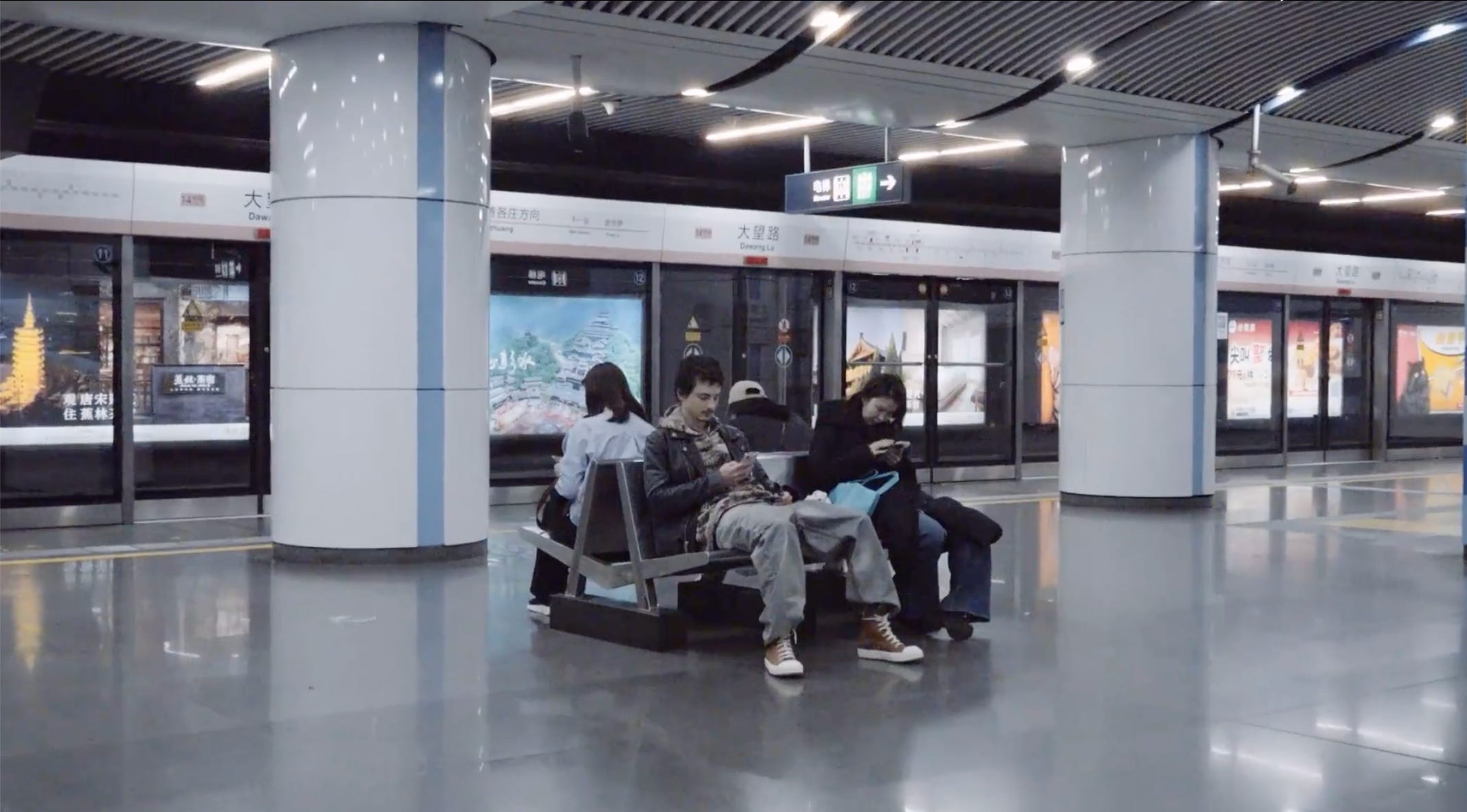
Before you read any further, watch these two short clips from this campaign. The editor manages to turn what could have come across as 甜茶新春走基层 into a poetic musing on fame and solitude.
YANG (Host, CyberPink):
I’d like to thank the algorithm for serving me the Beijing metro video before the tofu one. (Also if you’ve ever had moldy tofu, please tell me in the comments what it actually tastes like — I am so curious.) As Izzy said, whoever edited that video did an exquisite job. That Timmy blends so seamlessly into a Beijing subway car has everything to do with the fact that he’s a New York kid. Anyone who’s been ground down by a big city recognizes it viscerally: this is one of those trains just after evening rush hour, when the flood of commuters has thinned to a trickle. Everyone is either sitting with their eyes closed, or plugging AirPods in to drown out train noise with even louder music, or pulling the slot machine on their phone for a hit of dopamine.
YIWEN:
Yes — the metro video jump-cuts from Timmy as your normal soulless Beijing 社畜 to Chalamet as the red carpet star. The one where he bought a Sun Yingsha poster I liked even better; it reminded me of the gritty, street-level filmmaking in Uncut Gems. In both videos, and by extension this entire press tour, the goal seems to be presenting Timmy as just another guy living in China. It worked. Isn’t it a little ironic how easily he blended in?
Fun fact: there have been discussions on Xiaohongshu about the editor behind those videos. A millennial lifestyle influencer (sorry) came out on Weibo to drop the lore of her friend — the unnamed, talented editor finally being discovered by the world through this clip. I’d be really curious to find out who else is on Timmy’s team. Who came up with the moldy tofu scene? Also, in that video, Timmy says to the camera: 你什么意思. That’s the same line Paul Atreides delivers to Dr. Yueh in Dune: Part One. Delicious Easter egg.
YANG:
Timmy has a distinctive urban hooligan/小瘪三/混子 energy. After Marty Mauser possessed him, this energy got more pronounced. New York and Beijing both breed this kind of small-time hustler; the art that comes out of both cities has always had a soft spot for them. They’re portrayed as resourceful, scrappy, quick on their feet, very punchable, but somehow more lovable. This 瘪三混子 archetype is a romanticized, heroic projection of ordinary urban life: sure, I am nobody, but just watch me — if you fuck with me, I will still draw blood.
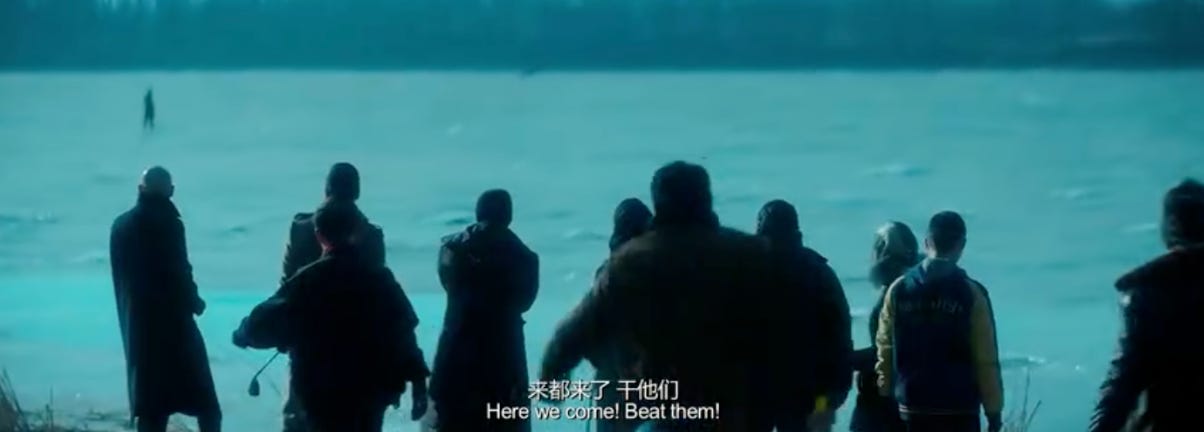
Watching Marty Supreme reminded me of 老炮儿 (criminally translated as Mr. Six, a title that loses everything). That film caught criticism when it came out. Its director Feng Xiaogang — a cultural icon of 大院子弟, someone who grew up behind the walls of Beijing’s privileged Party compounds — cast himself as 六爷 aka Mr. Six, a bottom-rung Beijing local. The villain is a designer-clad rich kid who, of all things, challenges the old guard to a fight on a frozen lake behind the Summer Palace. Mr. Six dies of cancer on the lake before the fight even breaks out — but achieves the highest form of fulfillment. All of his brothers and his former lover showed up to witness his heroism.
Both 老炮儿 and Marty Supreme share a fierce nostalgia for an urban ethos: way back when, in some not-so-distant past before the rules of the game fully calcified, we weren’t yet the domesticated urban middle class we’ve since become. People didn’t make their living by clocking in nine-to-five, but by their wits and the loyalty of their crew, hustling and improvising their way through. The city was still a 江湖 — the whole world is the underground world — and there’s always room for a hero to write his own story. 六爷 and Marty Mauser are both men chasing something that will probably destroy them, and the films wants us to love them for it anyway.
YIWEN:
The Chinese internet has in recent years placed enormous emphasis on 活人感 — the “vibe of being alive” — among celebrities. It’s a backlash against polished millennial internet culture (sorry again) where everything had to be filtered, flawless, and perfect. This vibe shift is obviously happening on the American internet too, but it would be tougher for most Western celebrities to crack in China. Here, it’s still relatively easy to be authentic and get loved. As many comments about Chalamet’s tour went: 闯中态度很好 — proactive attitude breaking into the China market — a phrase usually applied to K-pop groups trying to build rapport. People notice whether a celebrity bothers to speak Chinese, leans into local memes (moldy tofu), and shows up to everyday activities (ping pong with grandparents). It’s worth saying clearly: the authenticity here was real, and it was also produced — by a skilled Chinese editor, a significant marketing budget, and a team that clearly understood the assignment. Those two things are not mutually exclusive. The seams just happened to be invisible.
IZZY:
I want to step back for a sec — a brief orientation in the semiotics of 甜茶. It’s a phonetic accident that became destiny: the first syllable of “Chalamet” sounds like chá/茶, and the rest is just vibes — he’s pretty, delicate, and has the face of someone who would grace the cover of every gray-market Boys’ Love (yaoi/danmei) novel my generation of Chinese women grew up reading. The origin of his Chinese cult status is Call Me By Your Name, a film that never received a theatrical release in China — and yet was one of the most-discussed, most-screenshotted films on my corner of the Chinese internet at the time. Timmy will forever be the boy weeping into a peach in the Lombardy countryside: the 白月光, the “white moonlight,” a figure of yearning that can’t be consummated.
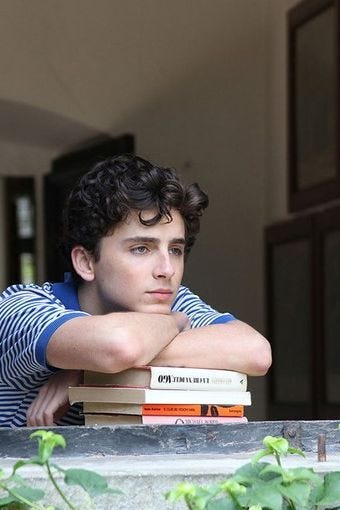
In the decade that followed, danmei fandom went from fringe subculture to undeniable mainstream. I was recently at a Shanghai shopping mall run by a state-owned enterprise where an entire floor was devoted to homegrown danmei merchandise — buttons, novels, manga. The Communist Party and the boys’ love industrial complex, coexisting peacefully under one roof.
But here’s the thing about white moonlight: it is more beautiful in memory than in reality. When 甜茶 landed in Chengdu — the gayest city in China — in a Marty Supreme Nahmias jacket to sell fermented tofu and get destroyed at ping pong by retirees, he was no longer that boy.
Because the Timothée Chalamet of the American tabloid imagination is not, to put it gently, a figure of ethereal yearning. He’s the guy who dates Kylie Jenner, makes a scene at a Beyoncé concert, and is prone to the specific kind of chaotic self-sabotage that only very beautiful people with very good publicists can survive. Marty Mauser, basically, but with generational wealth.
YIWEN:
Chat, I’m heartbroken.
YANG:
The world mourns with you.
YIWEN:
Talk about my own nostalgia for a not-so-distant past. I’ve watched every one of Chalamet’s early films — CMBYN, Beautiful Boy, Little Women, even A Rainy Day in New York (it’s funny) and a rewatch of Interstellar (he was just a baby). It takes a while to accept the truth: at his core, he’s an American frat boy who has grown up. What I mean by the swag gap is simple: the boy who played Elio has fully vacated the premises, and in his place is a guy who has decided his own celebrity is more interesting than the characters he plays. That said, I’m slightly jealous of this generation of American celebrities’ ability to simply ignore what used to define their careers and move on. How much I missed the twinky boy doesn’t really matter.
The timing of the China tour also coincided with growing backlash against Chalamet in the U.S. Just before the Oscars, he made a controversial comment about the irrelevance of opera and ballet. Hardly out of character, really. The overall reception of the campaign in China has been quite positive — we’ll see if that shows up at the box office.
YANG:
The K-pop fandom has a word for this: namjabyeong — when an idol stops being content as an object of projection and starts asserting his own masculine identity. My feelings about it are complicated. I’m deeply wary of the control East Asian fan culture exerts over an idol’s exploration of their own identity. But Timmy isn’t a teenage HYBE trainee; he’s an A-list movie star in his thirties. The world dotes on him the way Beijing dotes on its 老炮儿, and they won’t miss me in the crowd. Some men simply get to become themselves, and the rest of us adjust.
What’s interesting is that in the whole Chinamaxxing trend, many Western men found in China a very rough, folksy, Beijing-uncle masculinity. Japan is claimed by the sensitive, cultured, artsy bunch; Korean masculinity is already filtered through the female gaze via K-pop. But Chinese masculinity is organic, free-range, grass-fed manhood: lifting your shirt in public as if women don’t exist, smoking in enclosed spaces as if children don’t exist, gaining weight and accumulating chronic diseases as if aging doesn’t exist. It is untainted by the long, grinding negotiation of learning to share the world with others. These guys have stumbled onto a revelation: China is a country where being a man feels great.
China is for the bros. Timmy is a bro — what a perfect match.
New Episodes from Baihua:

EP79 | 伊朗战事、中期选举第一枪、DHS换人 Iran war, midterms fire up, and a DHS shakeup

EP77 | Vibe Shift 三部曲:匮乏时代的流行文化 Popular culture in the age of scarcity

EP18 对话《纽约客》作者刘亦灵:在算法和审查中寻找灵魂自由的舞动 A conversation with Yi-Ling Liu on ‘Wall Dancers’


EP17 关于照护的故事,电影有更激进的想象 ‘Rosemead’, ‘Take me home’, and telling stories about caregiving

EP19|妈妈,如果我是蟑螂你会爱我吗 Mom, If I Were a Cockroach, Would You Still Love Me?
Thanks for teaching me the word 瘪三
The Beijing subway vlog (so good) giving full "lonely boy"vibes, I am definitely overthinking this but perhaps it's paying homage to Dan Humphrey (another New Yorker native like Timothee) who on his commute from UES to Brooklyn imagines his inevitable glory as a celebrated writer, then vlog shot cuts in a dramatic revelation..to Sweet Tea at his movie premier signing for fans.
LOVE this chat please share more chats.