


One gift of being terminally online across the porous borders of the U.S. and Chinese internet is watching your mind build an encyclopedic map of memes spanning both worlds. Eventually, those worlds collide.
Dark memes have become the language of choice for a disillusioned Gen Z in both countries—a shared language for the chaotic, the angry, and those desperate to obliterate a stagnant status quo. In this issue, we look at a bizarre case of this convergence: how an American mass shooter, radicalized by domestic extremism, became the face of Chinese Gen Z’s economic despair.
How did we get here? Before Ray —our New Zealand-based, perpetually online social media editor—walks us through the absurd Chudjak mashups, before which CyberPink’s Yang takes us on a necessary detour regarding the death of a certain Chinese influencer.
Trust us: it’s all connected.
Yang, CyberPink host:
On March 24, 2026, Zhang Xuefeng died of sudden cardiac arrest in Suzhou at just 41.
Zhang was a college admissions consultant who livestreams for hours every day to millions of anxious Chinese parents. In the 2024 gaokao season, he sold out 20,000 consulting slots—priced at $2,600 each—within hours. He regularly starts cultural wars, famously telling parents to knock their kids unconscious before letting them major in journalism (gasp), and declaring the humanities strictly for the service industry (gasp gasp gasp.)
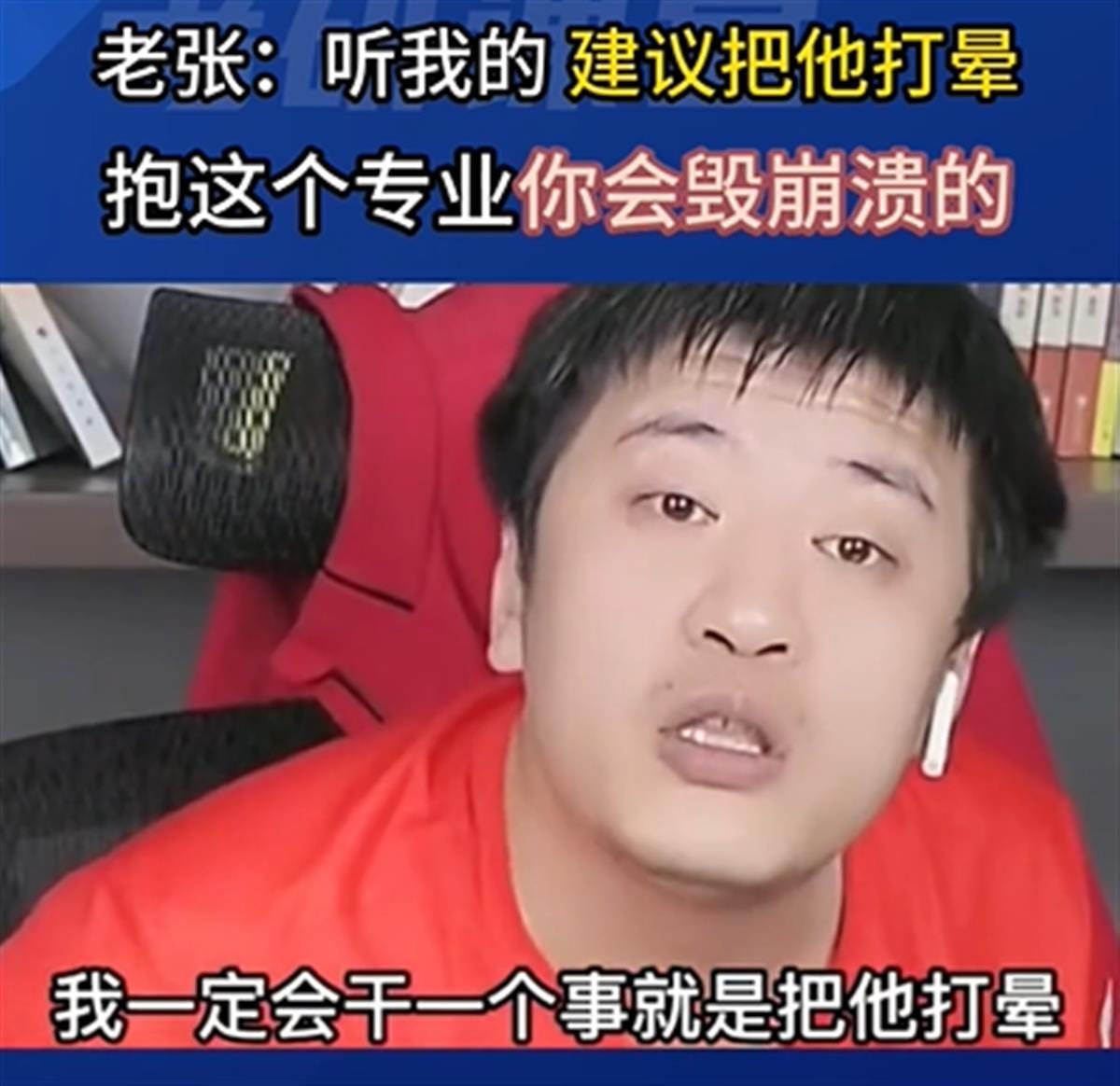
Zhang’s popularity stemmed from his deep understanding of the fake meritocracy that is the Chinese gaokao. For all the American debate over standardized testing and affirmative action, China’s system — despite the spectacle of fairness where the nation grinds to a halt for two days — is perhaps equally class-dependent, and more openly so.
Your odds is determined at birth, and you can actually do the math with public data. Every university sets different score thresholds by province (分数线). I grew up in Shanxi, one of the four notorious “Mountain and River Provinces”—regions with massive populations and the hardest tests. For my province, fewer than 200 out of 300,000 students make it into Tsinghua or Peking University. The odds of my peers in Beijing are 15 times higher, with the same school recruiting triple the amount of students in a smaller pool.
Then there is the major-selection gamble. For the same school, the gap between the cutoffs for a Computer Science major and an Environmental Science can be 50 to 100 points. A well-connected urban family knows which majors lead to jobs, which cities are worth relocating to, which schools punch above their weight, whereas a farming family has none of this information.
Zhang’s method was essentially a caste calculator. He looked at four variables: gender, hukou (urban or rural), household income, and scores. If you were a rural girl with mid-range scores, he would advise you pick a service-oriented major in a lower-tier city near a male-dominated engineering school, so you can find a local husband with an urban hukou. For a middle class small city boy with the same score, he insisted you must go to the biggest city possible—Beijing or Shanghai—and pick a STEM major at any school that lets you maximize your hustle.
When you have that much influence it becomes hard to tell whether you are explaining the system or reinforcing it. His defenders said he was the only person willing to give poor families the strategic information that rich families already had. His critics said he rebranded sexism and inequality as “the way things are.” Both were right.
As you can probably tell, I’m not writing from a neutral place. I still carry the cured resentment of a student who had to believe that the uneven playground was a force of nature. But as a millennial, my gaokao year was the year that China became the world’s second-largest economy. I never seriously doubted that there would be room for me too, as long as I worked a little harder, hustled a little more.
Now every time I look at the current Gen Z and Gen alpha college students, it is hard not to worry. The competition is just as rigid, but the payoff has became uncertain. And this uncertainty is breeding a cynical gloom, which further breeds school-maxxing influencers like Zhang and some very high-quality, very dark memes.
Ray, social media editor:
When TikTok refugees flooded Xiaohongshu a while back, they finally put the platform on the Western map, revealing a hidden, hyper-vibrant hub of Chinese youth culture. To track and decode the platforms’ memes has perpetually been a fun and cerebral exercise.
During one midnight doomscrolling session in late 2023, this overstimulating mess of an image slid into my feed:
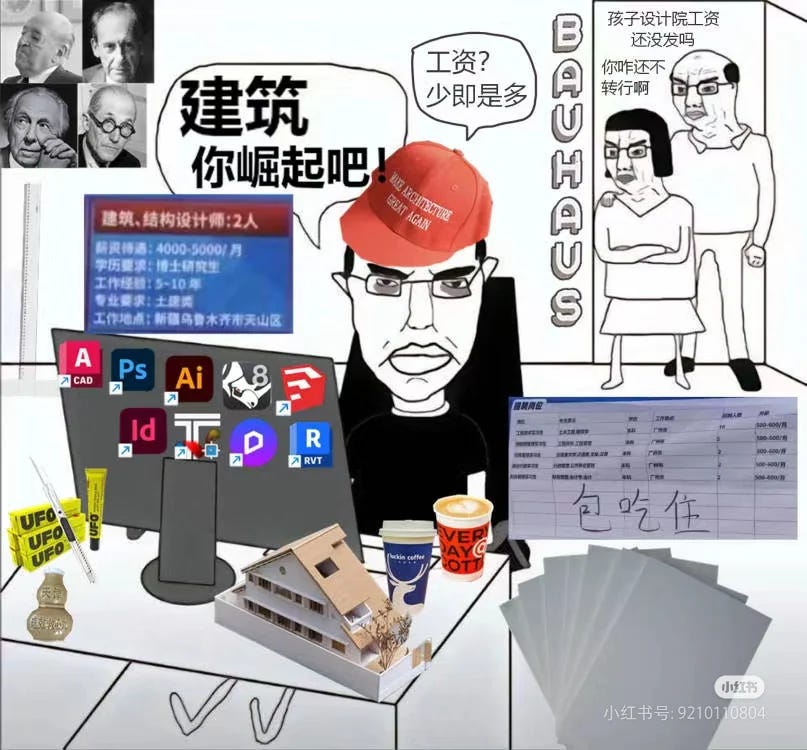
Titled “Architecture, you must rise up,” the sloppily composed meme featured a sleep-deprived graduate buried under piles of coffee, glued models, and job listings—all watched over by a pair of visibly disappointed parents.
It was a scene any of my fellow Gen Z could feel in their bones, regardless of their major. It instantly clicked with me (and evidently thousands of others who liked the post.)
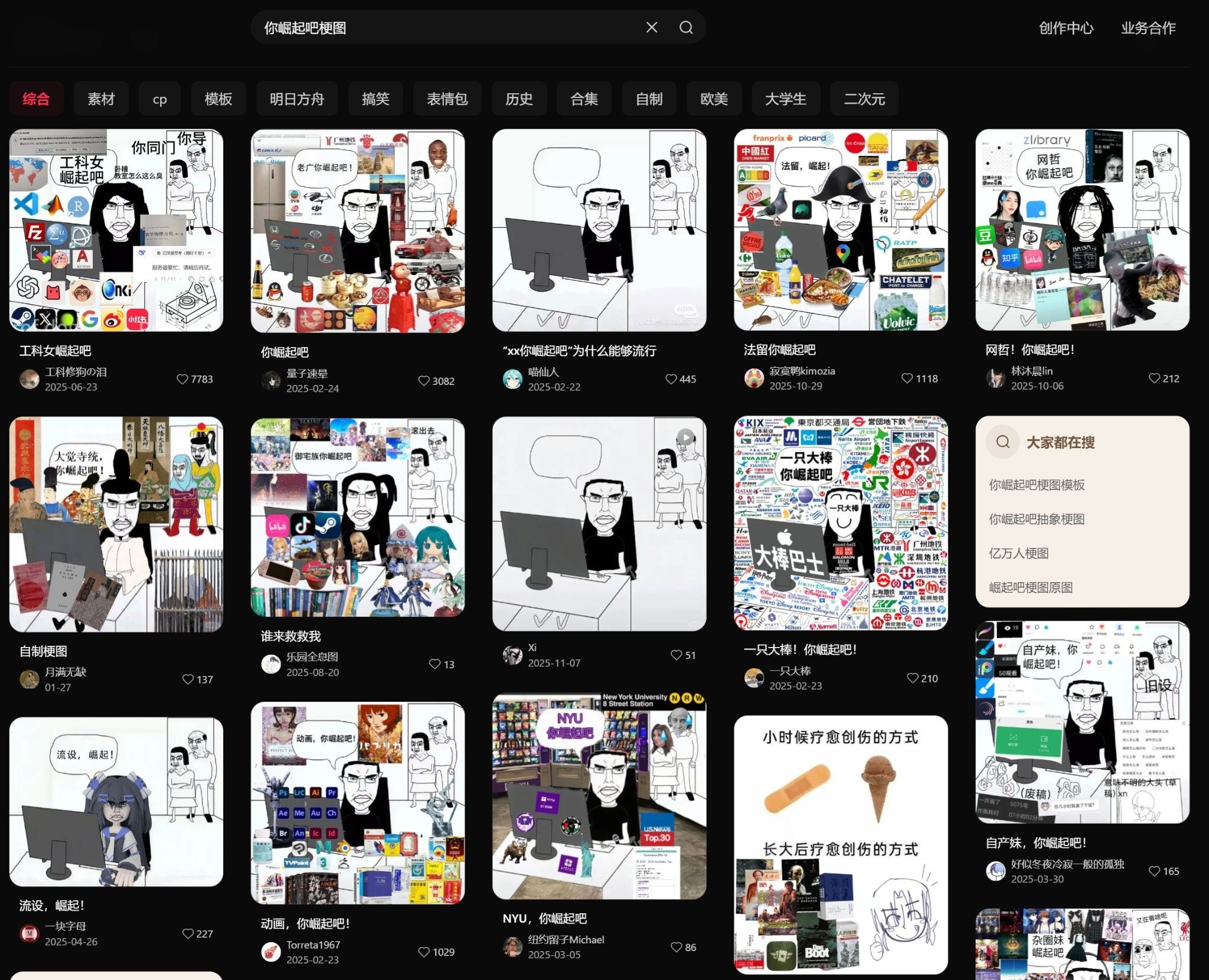
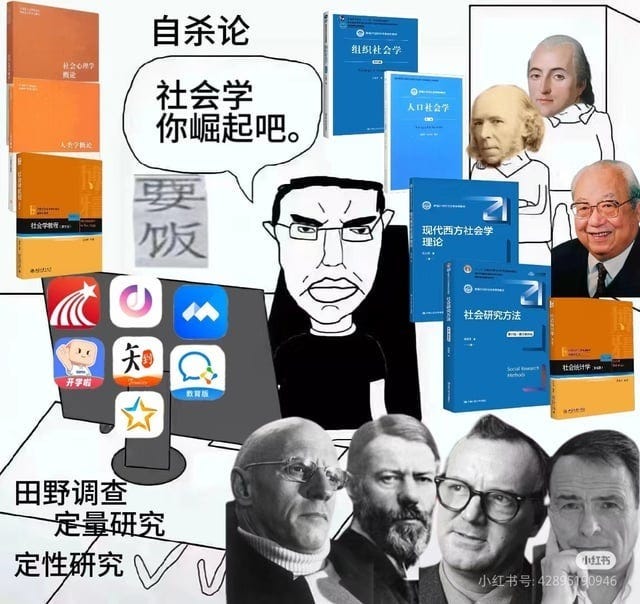
Naturally, the algorithm went to work. Within a minute, I was served a dozen variations spanning every college major from botany to sociology. But the relatable dark humor contained a chilling detail: the face in the meme belonged to Patrick Crusius, an American mass shooter.
How on earth did an American domestic terrorist become a mascot for Chinese youth anxiety?
afra:
What’s interesting is that when Ray first showed me this meme, I recognized the vibe instantly, even without the context. It had that specific stress-maxxing quality. It’s an emotionless expression that resonates with young people who feel fundamentally disempowered, buried under the accumulated weight of life’s expectations.
Ray :
Of the many U.S. mass shootings, the 2019 El Paso massacre stands out for its digital legacy. Before killing 23 people at a Walmart, 21-year-old Patrick Crusius posted a manifesto to 8chan with a chilling caption: “IT’S TIME.”
The manifesto went viral despite efforts to take it down. In the corners of 4chan and Reddit, the reaction was a toxic mix of praise and mockery. Critics dubbed Crusius a chud—slang for a loser right-winger—and someone eventually traced his face in the style of the infamous Wojak memes. Just like that, Chudjak was born.

The Chudjak was forged in the toxic primordial soup of anonymous imageboards, quickly mutating into two dominant species. One is the accelerationist variant, captioned with the nihilistic slogan: “The West Has Fallen. Billions Must Die.” The other is the basement-dweller archetype: a shut-in at his desk, surrounded by the cluttered iconography of online radicalization.
Both versions went viral as parodies of exactly what Crusius was: a disappointed young man poisoned by the internet. Eventually, the shock of the El Paso shooting was scrubbed away by the sheer velocity of the meme. The manifesto itself was mocked into irrelevance, but the underlying rot, that feeling of being promised a future that never showed up, remained as potent as ever.
Hidden among the rhetoric of Crusius’s manifesto was a single, haunting sentence: “My whole life I have been preparing for a future that currently doesn’t exist.”
If you strip away the ideology, that line could be seen as a raw admission that the social contract is broken. We can all guess the future he was talking about: the once reliable path where a steady job meant you could afford a house, a family, and to retire before growing old. But for young men coming of age in the 2010s in the U.S., that path became rocky, or even unattainable.
Crusius’s answer was a violent delusion, but the spark was a universal anxiety. It’s a bleak, shared frequency that somehow bridged the gap between a Texas Walmart and the feeds of Chinese Gen Z.
afra:
One thing I’ve noticed in this era of algorithmic feeds—with TikTok (which is Chinese-born, duh) eating up everyone’s attention—is that Eastern and Western memes have started to bleed into each other. This bi-directional swap of viral chaos is happening in real-time, and the Chud meme is a perfect, weird example of that convergence.
Ray:
Early Chudjak posts evolved as it spread on Xiaohongshu. By some weird digital alchemy, Xiaohongshu eventually settled on a singular Chinese Chudjak template: “Billions Must Rise” (亿万人必须崛起). It’s a seemingly inspirational tag, usually followed by a hashtag of a college major.
The face and the bedroom are the same, but the extremist symbols are replaced by a new kind of clutter: textbooks, CAD software, job applications, and painkillers. The disappointed parents remain in the background, a permanent fixture of the Gen Z psyche. It is a surreal context collapse—the face of a mass killer has drifted across the ocean, stripped of its original hatred until only the emotional core remains: pure, unadulterated stress.
Numbers from both sides of the Pacific tell the same story. American students owe more than $1.8 trillion in student debts while Chinese families on average spend 17% of household income on education. But this generation of graduates face worse earning potential and class mobility than their parents.
Chinese Gen Z was sold a simple contract: study hard, pick a useful major, and earn a stable life. That future has vanished. Despite his pragmatic branding, Zhang was essentially trafficking in nihilism, profiting off of the very anxiety he claimed to alleviate. The old slogans, like “Success comes to those who persist” or “Sweetness follows the bitter,” are still plastered on the walls in Chinese high schools, but they now sound empty and mocking.
At its core, this is just how memes move now. Something that started out as hyper-specific and toxic gets flattened into a template with collapsed context. By the time it shows up on Xiaohongshu, the Chudjak is just sitting there between travel vlogs and relationship advice.
But it functions without context precisely because the feeling is the context. Most people on Xiaohongshu probably don’t know where the face comes from, and for a generation living through the death of the future, it doesn’t really matter.
Yang:
Remember the time you learnt a skill at school and you felt good about it, that it did not feel like a waste of time? Everywhere around the world we ask ourselves, what is the value of education anyways. Is it a caste-based resource distributor for young people, triaging hopes and dreams to different social classes, like Zhang believes? If that is true, what is the value of training ourselves to learn skills to survive in a world that no longer exists?
Perhaps Xiaohongshu’s nihilistic optimism is the way to go. We hold on to the wisdom and wonder of what was created before us, the hard-learnt skills we acquired, and shake our fist a little bit — who knows, what if we did 崛起?
What we talked about at Baihua
083 | AI 成年礼:从”最聪明的模型”到”最烫手的政治问题” AI Goes Political
We talked about AI, and broke down the Anthropic vs. Pentagon drama.
020 写完这本书,35岁就可以死了 Lemme put this book together so I can die at 35
We had a funny conversation about death.
019 孤独症接纳月,不要再把行为描述为问题 Things you need to know in Autism Awareness Month
We had a soulful talk between educators and parents about autism.
081|巅峰对决:不好了队长他们都在搞对象 Heated Rivalry and the radical joy of sm*t
A joyful chat about “Heated Rivalry,” and why yaoi is a political conversation.
020 林三土:什么是自由?Political Philosophy 101: What is Freedom
021 林三土:什么是民主?Political Philosophy 101: What is Democracy
A banger two-part political philosophy lecture by the fantastic 林三土, because we only talk about the hardest problems here on 选修课Universus.
This issue of the Baihua newsletter is edited by Izzy and Yang.


This disillusionment isn't unique to China. It's also true for Gen Z in the US and probably across the globe. For young Americans fresh out of college, the current job market feels as abysmal as 2008. When the weight of tens of thousands in student loans no longer guarantees a white-collar career, it serves as a universal wake-up call. The structure is clearly unstable, which probably propels the doomer and accelerationist mindsets online.
The pressure is only the symptom, the real issue is that this system doesn't work anymore. The Chinese government is trying to encourage more blue-collar workers and reduce the number of college graduates to combat this problem, but it's hard to say whether that will show quick promising results. I think both the US and China are trying to find a way.
Another day, another afra writing that makes me feel like a fake Chinese Gen Z lol. Learned so much!